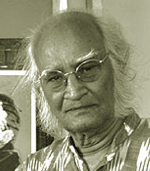
| |  Born 1918 in Dacca, Late Shree Paritosh Sen studied art at the School in Madras from 1936 to 1940. In 1943 he moved to Calcutta where, together with his other artist friends he formed the Calcutta Group in the field of Visual Arts. In 1949, he left for Paris where he studied at the Atelier of Andre Lhote, Academy Grand Chaumier, Ecole des Beaux Arts and Ecole de Louvre till 1954. Though from the very start Paritosh’s work remained figurative and the human figure his main forte, he could never become burdened with formalism or of purism. In delineation, he might have taken to heavy brush strokes with Reds, Blues or Yellows or in Patua style, but he continued to be conscious of giving volume to the figures. And indeed this concern for the volume gave his pictorial venture a satirical twist. Whatever he painted, seemed to come out of the time and chemistry of the soil in which Paritosh had kept his faith anchored. Following his first solo in 1950 Paritosh Sen had held several shows in India and abroad. In 1961, he exhibited with Tyeb Mehta in London. Subsequent shows abroad included the Commonwealth Arts Festival, Four Indian Painters, Pittsburg, USA, Biennales of Sao Paulo, and Cuba and Asahi Shimbuan, Tokyo in the 60s and 70s. Paritosh Sen was recipient of a fellowship from the French Government to design a Bengali type face based on Tagore’s hand writing and John Rockfeller III grant to travel to America both in 1969-70. In 1987, the Lalit Kala Akademi honoured him by electing him a Fellow. In 1989, the West Bengal Government honoured him with Abanindra Puraskar. He was also conferred a D. Litt, Honoris Casua by the University of Burdwan and in 2002 by Rabindra Bharati University. He was also conferred with the Medalion by the Republic of France with the inscriptions ‘L. Officier de l’orda des Arts et des Lettres.’ In the year 2004 the Lalit Kala Akademi awarded him the ‘Lalit Kala Ratna’ along with his contemporaries.
| These works have a keen sense of drawing. The characters with accessories are like part of a concentrated narrative. Paritosh Sen had also been a literati and a major portion of his works form manuscript illuminations of his writings. These works too share the elements of fine manuscript illumination formed through a diverse experience of Kalighat Pata, tribal art, Expressionistic works. But a selection of definite compatible elements from all these categories gives the character of Paritosh Sen’s works. The highly expressive and animated figures in the works are a visual treat. back to show >> |